How Underwater Drones Reshape Naval Warfare
Undersea warfare has traditionally been dominated by ultra-expensive platforms, costing billions to purchase and operate, placing meaningful undersea capability beyond the reach of many smaller militaries.
But just as in the air, unmanned systems are beginning to lower that barrier, enabling less well-funded opponents to deploy capable platforms at scale and challenge forces that once held an overwhelming technological advantage.
The Latest Advances in Military Underwater Drones
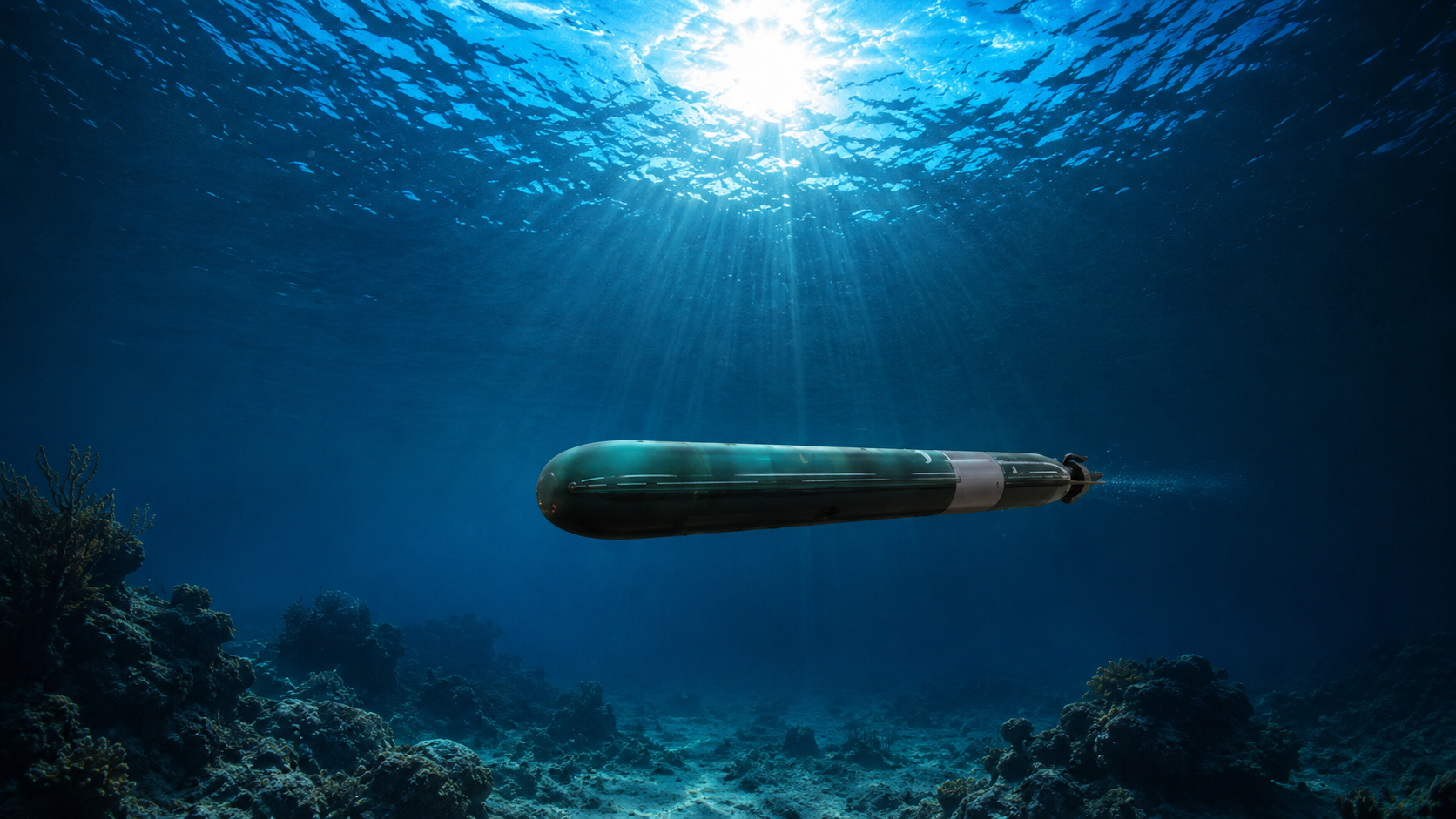
The new generation of underwater drones is equipped with state-of-the-art inertial navigation: Doppler velocity logs, sonar, computer vision, and AI-powered sensor fusion.
This combo allows unmanned underwater vehicles (UUVs) to autonomously cruise through poor visibility conditions without losing the route or continuously referring back to the operator for instructions.
So militaries gain a comparatively agile way to survey contested waters, hunt mines, monitor infrastructure, deliver payloads, and, increasingly, attack way more high-value targets. To boot UUVs, they can be deployed in larger numbers for more dangerous missions without as much remorse if the mission doesn’t go as well as planned.
Ukraine’s underwater drones lead the way in naval warfare
Ukraine has already demonstrated the strategic impact of inexpensive uncrewed vessels in the Black Sea.
Since 2022, its remotely operated surface drones (including the Sea Baby family), have struck Russian ships, naval facilities, the Crimean Bridge, and a slew of other high-profile targets, helping force much of Russia’s Black Sea Fleet away from Sevastopol.
Newer Sea Baby variants, released in 2025, reportedly have ranges of up to 1,500 kilometres and payload capacities reaching 2,000 kilograms. These crafts are primarily surface vessels, but Ukraine is now extending the same asymmetric model underwater.
In December 2025, the Security Service of Ukraine said domestically developed Sub Sea Baby drones attacked a Russian Kilo-class submarine at Novorossiysk. Russia denied that the vessel was damaged. However, verified footage showed an explosion beside the submarine’s berth. The operation was described by Ukrainian officials as the first underwater drone attack to neutralise a submarine.
Ukraine’s industrial pipeline is also expanding. Toloka has recently presented a family of underwater drones ranging from compact systems intended for reconnaissance and covert approach missions to larger platforms reportedly capable of travelling up to 2,000 kilometres. It can be deployed for surveillance, mine-laying, communications relay, logistics, and strike missions.
More recently, Ukrainian company Global Mark has unveiled an even more impressive development: Sea Trident — a 10-metre autonomous underwater drone designed for long-range missions. The manufacturer says it can carry payloads of up to 1,000 kg (2200lb) and perform strike, logistics and UUV-interception missions. The claimed range is approximately 2,000 miles, although these specifications are yet to be demonstrated in combat.
The threat is already reshaping Russian naval defences. In March 2026, the research vessel Lagoda was photographed in Novorossiysk fitted with metal cage-like structures, camouflage netting and an electronic-warfare system — an improvised last line of protection against Ukrainian underwater drone attacks.
US Navy Underwater Drones Get Deployed Across the Hormutz Straight
The United States has pursued a more established, mission-specific application: mine countermeasures.
General Dynamics’ Knifefish is a medium-class naval drone designed to detect, classify and identify buried mines and targets hidden in cluttered seabed environments. It can be launched from Littoral Combat Ships or other vessels, allowing the host ship and its crew to remain outside the minefield. It has been recently deployed in the Hormutz Straight to clear up mines.
More recently, the US Navy has confirmed a one-way attack with sea drones against Iranian targets. However, the deployment of UUVs has been part of a wider, integrated offensive, which also included American fighter aircraft, naval warships, and aerial drones. Earlier in the year, the US special forces conducted their first live-fire trials of Ukrainian Magura sea drones, deploying the platform against a target ship in the Philippines.
The US Navy is also developing proprietary underwater drones for offensive missions, but information on their use remains largely classified or experimental.
Autonomy Will Determine The Success of the Next Platforms
Further advances in underwater drone technology will be as much about the software as about hull size, range, or payload.
Advanced autonomous navigation capabilities hinge on the platform’s ability to interpret sensor data and make independent mission decisions.
OSIRIS OS provides a common operating architecture for aerial, ground, surface, and underwater drones, allowing developers to integrate different vehicles and autonomy modules within one ecosystem. For UUV manufacturers, this can shorten integration cycles and support mission planning, AI processing and fleet coordination without building an entire software stack from scratch.
Learn more about our technology.