How Evacuation Drones Are Changing Battlefield Casualty Rescue
Drones take on many roles on the battlefields — from ongoing reconnaissance and surveillance to active engagement via interception. More recently, however, they’re assuming a new role: personnel rescue.
Fresh reports from Ukraine’s frontlines describe injured personnel evacuations by heavy-lift aerial platforms. And the military is preparing to make such missions routine. In the meantime, European militaries also accelerate their trials of robotic evacuation technologies. In the Netherlands and Switzerland, several unmanned rescue systems were approved for use across active battlefields.
The future of evacuation drones is already taking shape on the ground — and here’s exactly how it looks.
Heavy-Lift Drones Rescue Wounded Soldiers Out of Combat Zones
In October 2026, Ukraine’s 92nd Brigade completed the country’s first casualty evacuation by drone from the frontline.
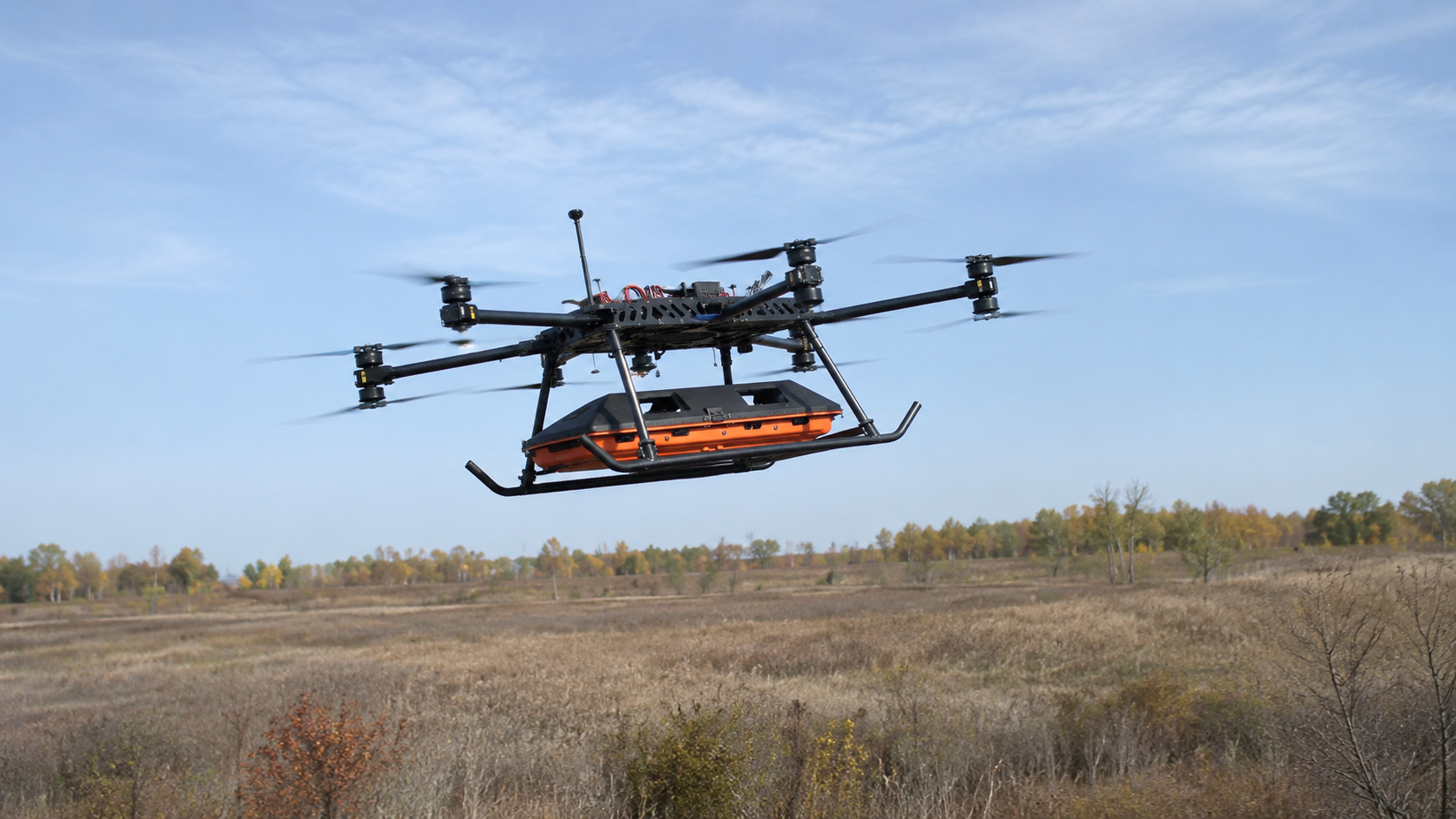
Shortly afterwards, the 475th Separate Assault Regiment carried out two more rescue missions using StarGate — an evacuation hexacopter developed by Ukrainian manufacturer SkyFall. StarGate has an evacuation module, based on certified medical stretchers. It can lift to 150 kg, while traveling at speeds up to 105 km per hour. During the rescue mission, Stargate carried the wounded soldier for over 30 km towards the nearest medical checkpoint.
The bigger breakthrough is how quickly drone evacuations can be scaled. The first aerial evac took 7 days of prep. But two weeks later, a similar mission was carried out in just 12 hours, thanks to improved coordination between pilots and ground medics.
Heavy-lift evacuation drones are an indispensable alternative for missions where ground access can be extremely dangerous. Mines, heavy shelling, water, or terrain obstacles often prevent ground teams from reaching casualties in time. Ruggedized aerial platforms can navigate through complex terrain faster to reach stranded personnel.
Following the demand, SkyFall plans to ramp up production to 1,000 StarGate drones per month by the end of 2026.
European Militaries Are Testing Evacuation Drones for Urban Combat
Ukraine isn’t the only country exploring unmanned casualty evacuation.
In November 2026, the European Defence Agency (EDA) and Swiss Armed Forces ran an ALPEX LOG exercise at Switzerland’s Bure military training area. The trials specifically focused on using unmanned systems to support frontline logistics and casualty evacuation in urban environments.
The teams tested several scenarios:
- Wheeled and tracked ground robots transported supplies and performed simulated casualty extraction.
- Aerial drones delivered supplies and conducted reconnaissance around buildings and surrounding terrain.
- Military logistics teams evaluated how these platforms could integrate into existing operational procedures.
Urban battlefields raise the stakes for evacuation missions. Narrow streets and debris from
damaged infrastructure can block conventional vehicles. And enemy surveillance can make exposed routes increasingly treacherous.
EDA’s trials specifically tested how different modalities can be used together for such missions and provided direct feedback to OEMs.
Ground Evacuation Robots are Becoming Faster and Better Protected
While aerial evacuation is relatively new, unmanned ground systems have already proved their mettle across numerous rescue missions.
During the latest European Defence Innovation Forum in the Netherlands, Ukrainian manufacturers showcased two next-gen robotic evacuation platforms.
- TENCORE — an armoured evacuation robot with ballistic protection and specialised camouflage to reduce its thermal signature. The platform has an autonomy unit and a range of AI-assisted control functions for programmed task execution. An onboard camera and speaker also help maintain comms with the transported casualties.
- Maul — a high-speed robotic vehicle designed to transport wounded soldiers inside a protective capsule. The ground platform has a range of up to 110 km on paved roads (and 90 km on dirt roads), with a cruising speed of 60 km/hour. Communications are ensured by fiber optics, as well as low-orbit satellite LTE and Wi-Fi. The transportation capsule features shock absorption and secure patient restraints for safe travel.
According to the manufacturer, Maul has already helped save more than 200 lives in combat.
Evacuation Drones Still Have Their Limits
Even as technology advances, autonomous casualty evacuation remains a tedious process.
The main unresolved issues include:
- Patient protection. Evacuation drones must haul people with severe injuries while maintaining a stable flight in a highly contested environment. Many OEMs are now working on improving the patient transportation capsules, as well as onboard navigation.
- Operational coordination. Rescue missions require close collaboration between drone operators and people on the ground. As Ukraine’s experience demonstrates, the efficiency of such missions can be actively ramped up. But this requires dedicated practice.
- Reliability under fire. Mechanical failures, hostile interceptor drones, loitering munitions, and other calamities can halt evac missions mid-air. A successful trial exercise doesn’t guarantee the same outcome in active combat. So many OEMs now focus on adding extra safety features to their platforms.
For evacuation drone technology to really take off (pun intended), the technology will have to become readily available beyond individual units and bounded trials.